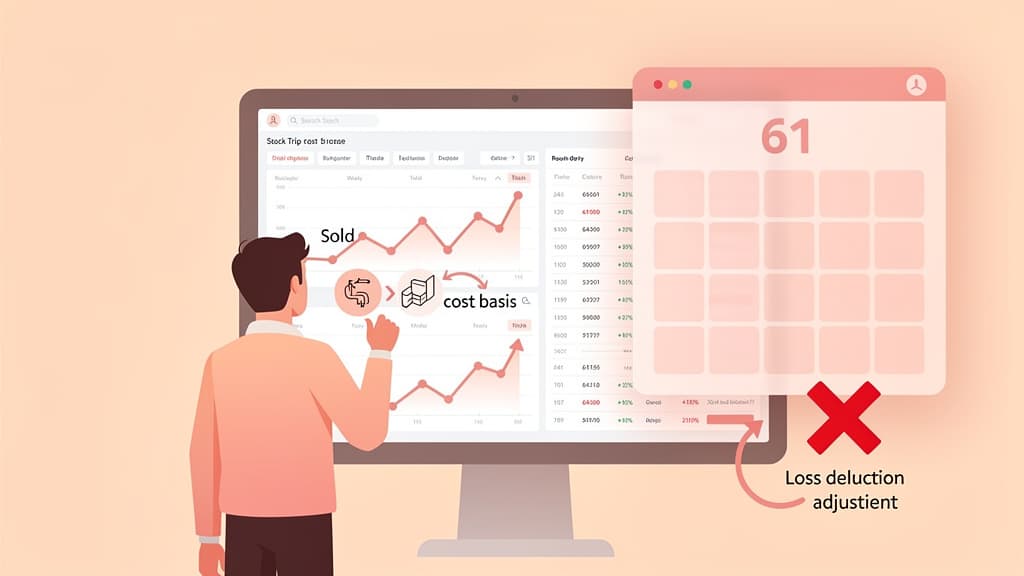
The wash sale rule, explained in IRS Publication 550 and set by IRC §1091, disallows your capital loss deduction if you buy the same or a substantially identical security within 30 days before or 30 days after selling at a loss. That creates a 61-day window: 30 days before the sale, the sale date itself, and 30 days after, all counted in calendar days, not business days. The disallowed loss is not gone forever; it gets added to the cost basis of the replacement shares.
Key takeaways:
- The window is 61 calendar days: 30 days before the sale + the sale date + 30 days after (IRS Publication 550, IRC §1091)
- A disallowed loss is added to the cost basis of the replacement shares, deferring the deduction rather than erasing it
- The rule applies across all your accounts, including IRAs and your spouse's accounts; an IRA repurchase kills the loss permanently (Rev. Rul. 2008-5)
- Cryptocurrency is not subject to the wash sale rule in 2026 because the IRS treats crypto as property, not securities
- Brokers flag wash sales with code W on Form 1099-B; you report them on Form 8949 and Schedule D

The wash sale rule is triggered when three conditions are met:
- You sell a stock or security at a loss
- You buy a "substantially identical" stock or security
- The purchase happens within the 61-day window (30 days before through 30 days after the sale)
When triggered, the IRS disallows the loss deduction. You can't claim it on your tax return for that year. However, the loss isn't gone forever. It gets added to the cost basis of the replacement shares you purchased.
IRS Publication 550 describes the window as 30 days before or after the sale. Counting the sale date itself, the full danger zone is 61 calendar days:
| Date | Event |
|---|
| February 13, 2026 | Window opens (30 days before the sale) |
| March 15, 2026 | You sell 100 shares of XYZ Corp at a loss |
| April 14, 2026 | Window closes (30 days after the sale) |
If you buy XYZ Corp (or a substantially identical security) at any point between February 13 and April 14, the wash sale rule applies and your loss is disallowed.
The count uses calendar days, not business days or trading days. Weekends and market holidays count toward the 30 days.
The disallowed loss doesn't disappear. It gets added to the cost basis of the replacement shares. This means you'll recognize the loss when you eventually sell the replacement shares, assuming you don't trigger another wash sale.
Example:
| Step | Transaction | Amount |
|---|
| 1 | Buy 100 shares of ABC at $50/share | $5,000 |
| 2 | Sell 100 shares of ABC at $35/share | $3,500 (a $1,500 loss) |
| 3 | Buy 100 shares of ABC at $38/share within 30 days | $3,800 |
Result: The $1,500 loss is disallowed for the current tax year. The new cost basis is $38 + $15 of disallowed loss per share = $53/share, and the holding period of the original shares carries over to the new shares.
When you eventually sell the replacement shares at, say, $60/share, your gain is calculated from the adjusted basis of $53, not $38. The original loss is effectively deferred, not eliminated.
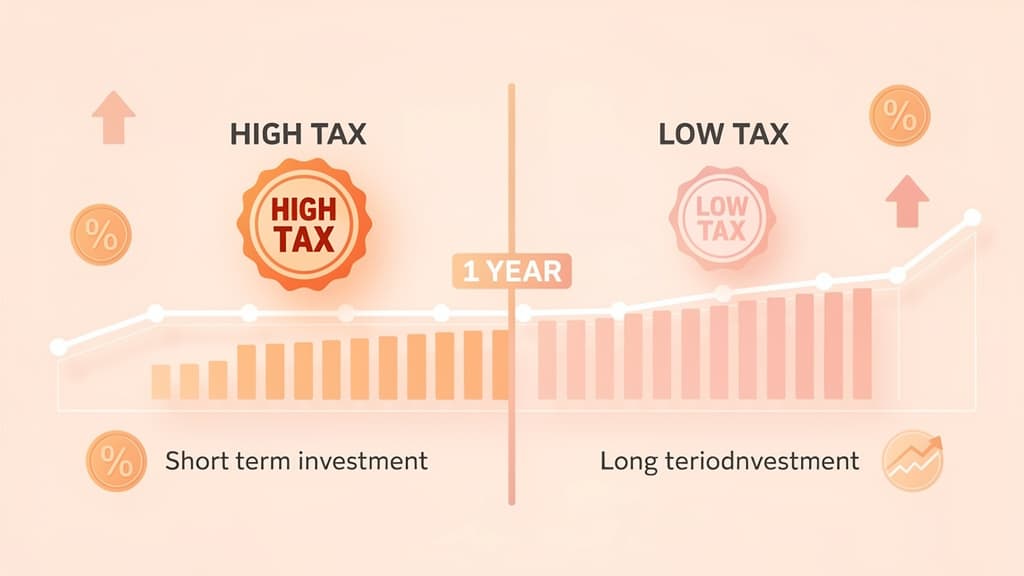
A reminder on why the loss matters: capital losses first offset capital gains, then up to $3,000 per year of ordinary income ($1,500 if married filing separately), with the rest carrying forward. The 2026 rate tables for the gains you are offsetting are in our Short-Term vs Long-Term Capital Gains Guide.
This is where the wash sale rule gets complicated. The IRS has never published a comprehensive definition of "substantially identical." Instead, they've issued guidance through revenue rulings and publications that covers specific scenarios.
These will trigger a wash sale:
- Same stock: Selling and rebuying shares of the exact same company
- Options on the same stock: Selling stock at a loss and buying a call option on the same stock, or selling a put option on the same stock
- Contracts to acquire the same stock: Any binding agreement to purchase the same security
These generally won't trigger a wash sale:
- Stocks of different companies: Selling Apple and buying Microsoft, even though both are tech companies, is not a wash sale
- Preferred vs. common stock: Usually considered different securities (unless the preferred stock is convertible into common stock at a price close to the conversion value)
- Bonds with different terms: Corporate bonds from the same issuer but with significantly different maturity dates, interest rates, or other terms
This is where tax professionals disagree, and the IRS hasn't provided definitive guidance:
-
Two S&P 500 index funds from different companies (e.g., Vanguard's VOO and iShares' IVV): These track the same index with nearly identical holdings. The IRS could argue they're substantially identical, but there's no ruling directly on point. Most tax professionals treat them as a gray area and recommend caution.
-
ETFs tracking similar but different indexes (e.g., an S&P 500 fund and a total market fund): These have significant overlap but aren't identical. Most practitioners consider these different enough to avoid wash sale treatment, but there's no guarantee.
-
Two actively managed funds in the same category (e.g., two large-cap growth funds): Generally considered NOT substantially identical because portfolio managers make different stock selections.
The safe approach: If you want to harvest a loss on an index fund, switch to a fund tracking a different index in the same asset class. For example:
| Instead of this... | Buy this instead |
|---|
| S&P 500 fund (500 stocks) | Total Stock Market fund (3,600+ stocks) |
| Russell 2000 (small cap) | S&P 600 SmallCap |
| MSCI EAFE (international) | FTSE Developed Markets |
As of 2026, cryptocurrency is NOT subject to the wash sale rule. This is because IRC §1091 applies specifically to "stock or securities," and the IRS classifies cryptocurrency as property, not a security (IRS Notice 2014-21).
This means you can:
- Sell Bitcoin at a loss on Monday
- Buy Bitcoin back on Tuesday
- Claim the full capital loss on your tax return
This is a significant tax planning advantage. While stock investors must wait 31 days or switch to a different security, crypto investors can harvest losses and immediately re-establish their position.
Congress has repeatedly proposed extending wash sale rules to digital assets. The Build Back Better Act (2021) included such a provision, but it was dropped before passage. Several bills in 2024 and 2025 proposed similar changes, but none have been enacted.
Starting in 2025, brokers must report crypto transactions on Form 1099-DA (with cost basis reporting beginning in 2026). While this reporting requirement doesn't change the wash sale exemption, it signals increased IRS attention to crypto taxation. Monitor legislative developments; this exemption may not last forever.
Bottom line for 2026: Crypto is still exempt. Take advantage of it while it's available, but keep detailed records of all transactions. For the full picture of crypto reporting, including Form 1099-DA, see our Crypto Tax Guide.
Yes. The wash sale rule applies across your entire portfolio, not account by account. One of the most common mistakes investors make is assuming the rule only applies within a single brokerage account.
If you sell stock at a loss in your Fidelity account and buy it back in your Schwab account within 30 days, it's still a wash sale. This includes:
- Multiple brokerage accounts (taxable accounts at different brokers)
- IRAs and Roth IRAs — If you sell a stock at a loss in a taxable account and buy it in your IRA within 30 days, you trigger a wash sale. Worse: because the replacement shares are in a tax-advantaged account, you permanently lose the disallowed loss. It can never be deducted because IRA gains aren't taxed the same way.
- Your spouse's accounts — Under IRS rules, your spouse's purchases can trigger a wash sale on your losses. If you sell Apple stock at a loss and your spouse buys Apple stock within 30 days, the wash sale rule applies.
The IRA scenario deserves special attention, because Rev. Rul. 2008-5 makes it the worst outcome possible. Suppose you sell a stock at a $1,500 loss in your taxable account, and buy the same stock in your IRA within 30 days:
- The $1,500 loss is disallowed in the taxable account
- The loss cannot be added to the IRA's cost basis (IRAs don't track basis the same way)
- The $1,500 loss is permanently gone
Always coordinate trading activity between taxable accounts and retirement accounts.
Yes, it can. If you hold mutual funds with automatic dividend reinvestment and sell shares at a loss, the automatic reinvestment counts as a purchase. Even a small dividend reinvestment within the 61-day window is enough to disallow a portion of your loss.
Solution: Turn off automatic reinvestment before harvesting losses, or switch the reinvestment to a money market fund during the wash sale window.
Wash sales are reported on Form 8949 (Sales and Other Dispositions of Capital Assets), which feeds into Schedule D (Capital Gains and Losses).
Your broker will typically report wash sales on your Form 1099-B with a code "W" in Box 1f. However, brokers only track wash sales within their own accounts. Cross-account and spousal wash sales are your responsibility to track and report.
For a wash sale transaction, you'll report:
| Column | Entry |
|---|
| (a) Description | 100 sh XYZ Corp (W) |
| (b) Date acquired | 01/15/2026 |
| (c) Date sold | 03/15/2026 |
| (d) Proceeds | $3,500 |
| (e) Cost basis | $5,000 |
| (f) Code | W |
| (g) Adjustment | $1,500 (the disallowed loss, entered as positive number) |
| (h) Gain or loss | $0 (loss fully disallowed) |
If only part of the loss is disallowed (because you repurchased fewer shares than you sold), you calculate the disallowed portion proportionally.
You don't have to repurchase the same number of shares to trigger a wash sale. If you sell 100 shares at a loss and buy back only 50 shares within 30 days:
- 50% of the loss is disallowed (attributable to the 50 replacement shares)
- 50% of the loss is allowed (attributable to the 50 shares not replaced)
The simplest approach. Sell the losing position and wait at least 31 calendar days before repurchasing. The risk: the stock could rise significantly during those 31 days, and you miss the recovery.
This is the most popular tax-loss harvesting strategy. Sell the losing security and immediately buy something similar but not substantially identical:
Examples:
- Sell a large-cap growth ETF → Buy a different large-cap growth ETF tracking a different index
- Sell individual stock → Buy an ETF in the same sector
- Sell a bond fund → Buy a bond fund with different duration or credit quality
- Sell an S&P 500 fund → Buy a total stock market fund
After 31 days, you can switch back to your original holding if you prefer.
Buy additional shares of the stock before selling the losing shares. Wait 31 days, then sell the original (losing) shares. Because you bought the replacement shares more than 30 days before the sale, no wash sale is triggered.
Caution: This requires extra capital and doubles your exposure to the stock during the waiting period.
If you sell losing positions in late December, the 30-day window extends into late January. If you wait until February to repurchase, you avoid the wash sale and can claim the loss on the prior year's return. Use the Capital Gains Tax Calculator to estimate your potential savings before executing this strategy.
Many investors only think about the 30 days after a sale. But if you bought shares of the same stock within 30 days before selling at a loss, that earlier purchase is the replacement purchase. The wash sale window looks backward too.
Your spouse's trades count. If you're married, coordinate your investment decisions during tax-loss harvesting season. A spouse buying the same security within the 61-day window triggers a wash sale on your loss.
Your broker only reports wash sales within their platform. If you trade the same securities across multiple accounts, you're responsible for identifying and reporting wash sales yourself. The IRS can cross-reference 1099-B forms across brokers.
This is the costliest mistake. A wash sale where the replacement purchase is in an IRA or Roth IRA means the disallowed loss is permanently lost. You can never deduct it. Always check your IRA trading activity during the 61-day window around any tax-loss harvest.
Even a small dividend reinvestment in a mutual fund can trigger a partial wash sale. Turn off automatic reinvestment before harvesting losses, or switch to cash settlement temporarily.
If you freelance and invest, tax time means Schedule C income, Schedule D gains, and Form 8949 adjustments all landing at once. Jupid is an AI accountant that connects to your bank accounts and categorizes business transactions with 95.9% accuracy, so the self-employment side of your return is already organized when you sit down to reconcile wash sales from your broker's 1099-B. You can also ask questions in WhatsApp or iMessage, like how a capital loss carryover interacts with your quarterly estimated payments, and get answers in real time. Try Jupid
- IRC §1091 — Loss from wash sales of stock or securities
- IRC §1091(a) — General disallowance rule (30-day window)
- IRC §1091(d) — Basis adjustment for replacement property
- IRS Notice 2014-21 — Virtual currency treated as property (crypto exemption basis)
- Rev. Rul. 2008-5 — Wash sales involving IRAs
| Item | 2026 Amount |
|---|
| Wash sale window | 61 days (30 + 1 + 30) |
| LTCG 0% threshold (single) | Up to $49,450 |
| LTCG 15% threshold (single) | $49,451–$545,500 |
| LTCG 20% threshold (single) | Over $545,500 |
| Capital loss deduction limit | $3,000/year ($1,500 MFS) |
| Crypto subject to wash sale rule | No |
The wash sale rule doesn't eliminate your loss. It defers it by adding the disallowed amount to your replacement shares' cost basis. The real danger is triggering a wash sale without realizing it, especially across multiple accounts or through automatic reinvestment.
Plan your tax-loss harvesting with the 61-day window in mind, coordinate with your spouse, and if you invest in crypto, take advantage of the current exemption while it's still available.
Disclaimer
This article provides general information about the wash sale rule and should not be considered tax or investment advice. The treatment of specific securities as "substantially identical" depends on individual facts and circumstances. Cryptocurrency tax treatment is subject to potential legislative changes. Your actual tax impact depends on your complete financial situation. For advice specific to your situation, consult with a qualified tax professional.
Last Updated: July 7, 2026