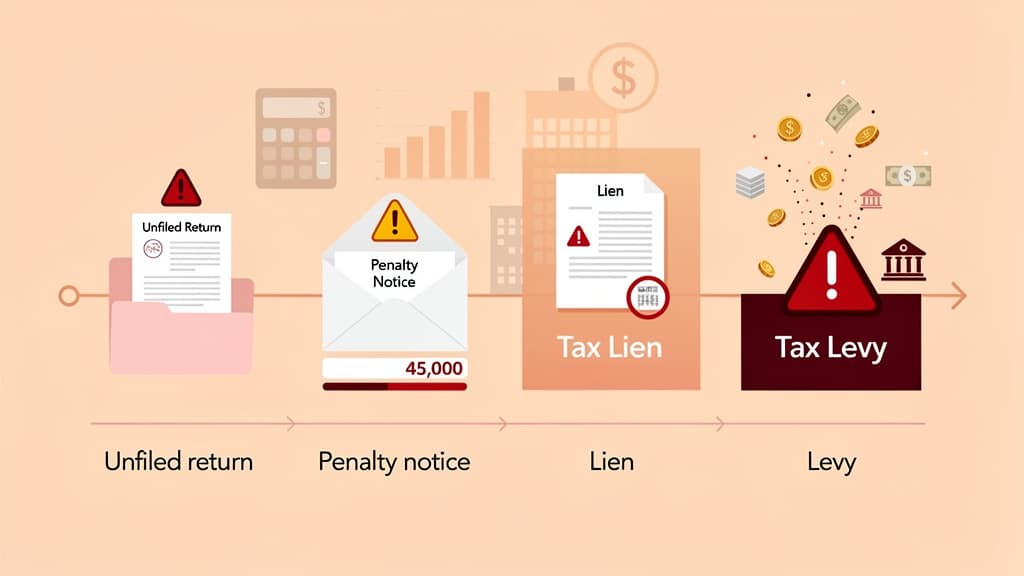
The 1099 due date for 2026 is February 2, 2026 for Form 1099-NEC — both the IRS copy and the recipient copy, with no extension available. Other 1099 forms (1099-MISC, 1099-K, 1099-INT, 1099-DIV) are due to recipients by February 2 but give you until March 2, 2026 (paper) or March 31, 2026 (e-file) to file with the IRS. Filing late costs $60 to $340 per form under IRC §6721, and the same penalty applies a second time under IRC §6722 if you also failed to send the recipient their copy.
Key takeaways:
- 1099-NEC: February 2, 2026 for both copies (the statutory January 31 date falls on a Saturday); no automatic extension exists
- 1099-MISC, 1099-K, 1099-INT, 1099-DIV: March 2, 2026 on paper (February 28 is also a Saturday) or March 31, 2026 e-filed; recipient copies still due February 2
- Late-filing penalties per form: $60 (fixed within 30 days), $130 (by August 1), $340 (after August 1 or never filed), $680+ with no cap for intentional disregard
- 10 or more information returns of all types combined means e-filing is mandatory
- The 1099-NEC minimum is $600 for 2025 payments (forms filed in 2026) and $2,000 for 2026 payments (forms filed in 2027)
All 2026 1099 deadlines:
| 1099 Form | Recipient Deadline | IRS Paper Deadline | IRS E-File Deadline |
|---|
| 1099-NEC | Feb 2, 2026* | Feb 2, 2026* | Feb 2, 2026* |
| 1099-MISC | Feb 2, 2026* | Mar 2, 2026** | Mar 31, 2026 |
| 1099-K | Feb 2, 2026* | Mar 2, 2026** | Mar 31, 2026 |
| 1099-INT | Feb 2, 2026* | Mar 2, 2026** | Mar 31, 2026 |
| 1099-DIV | Feb 2, 2026* | Mar 2, 2026** | Mar 31, 2026 |
*January 31 falls on a Saturday in 2026, so the deadline shifts to the next business day: Monday, February 2, 2026.
**February 28 also falls on a Saturday in 2026, so the paper deadline shifts to Monday, March 2, 2026.
Penalty structure (per form, returns due in 2026, per Rev. Proc. 2024-40):
| How Late | Penalty Per Form | Max (Small Business) | Max (Large Business) |
|---|
| Within 30 days | $60 | $239,000 | $683,000 |
| 31 days – Aug 1 | $130 | $683,000 | $2,049,000 |
| After Aug 1 / not filed | $340 | $1,366,000 | $4,098,500 |
| Intentional disregard | $680+ | No maximum | No maximum |
This guide covers the penalty tiers, extensions, corrections, and waivers in detail. If you need the employer-side calendar that puts W-2s and every 1099 on one page, that lives in the W-2 and 1099 employer filing deadlines guide.

You must file Form 1099-NEC if you paid a non-employee $2,000 or more during the 2025 tax year for services performed in your trade or business. This threshold was raised from $600 to $2,000 by the One Big Beautiful Bill Act (OBBBA), effective for payments made in 2026 (for forms filed in early 2027). For forms being filed in early 2026 (covering the 2025 tax year), the threshold remains $600.
Important note on the threshold change: The $2,000 threshold applies to payments made starting January 1, 2026. For the 1099-NEC forms you're filing now (covering 2025 payments), the old $600 threshold still applies.
Common recipients include:
- Independent contractors and freelancers
- Attorneys (regardless of entity type)
- Consultants and professional service providers
- Gig workers paid directly (not through a payment platform)
The 1099-NEC deadline is firm. Unlike most other 1099 forms, you cannot request an extension for Form 1099-NEC. Both the recipient copy and the IRS copy are due on the same date.
| Requirement | Deadline |
|---|
| Copy B to recipient | February 2, 2026 |
| Copy A to IRS (paper) | February 2, 2026 |
| Copy A to IRS (e-file) | February 2, 2026 |
| Extension available? | No |
Why February 2? The statutory deadline is January 31. In 2026, January 31 falls on a Saturday. When a tax deadline falls on a weekend or federal holiday, it moves to the next business day: Monday, February 2.
If you file 10 or more information returns of any type in a calendar year, you are required to e-file. This threshold was lowered from 250 to 10 returns starting in 2024. The count is aggregated across all information return types (1099-NEC, 1099-MISC, W-2, etc.).
For most small businesses with more than a handful of contractors, e-filing is mandatory.
Form 1099-MISC covers various types of payments that don't belong on a 1099-NEC, including:
- Rents ($600+)
- Royalties ($10+)
- Prizes and awards ($600+)
- Medical and healthcare payments ($600+)
- Crop insurance proceeds ($600+)
- Gross proceeds paid to an attorney ($600+)
- Fishing boat proceeds
- Substitute payments in lieu of dividends ($10+)
| Requirement | Deadline |
|---|
| Copy B to recipient | February 2, 2026 |
| Copy A to IRS (paper) | March 2, 2026 (February 28 is a Saturday) |
| Copy A to IRS (e-file) | March 31, 2026 |
| Extension available? | Yes: 30 days via Form 8809 |
Unlike the 1099-NEC, the 1099-MISC has separate IRS filing deadlines for paper and electronic submissions. You can also request a 30-day extension by filing Form 8809 before the original deadline.
The minimum payment that triggers a 1099 depends on the form. These are the 2026 filing requirements at a glance:
| Form | Payment type | Minimum amount |
|---|
| 1099-NEC | Contractor services (2025 payments, filed in 2026) | $600 |
| 1099-NEC | Contractor services (2026 payments, filed in 2027) | $2,000 (OBBBA) |
| 1099-MISC | Rents, prizes, medical payments | $600 |
| 1099-MISC | Royalties | $10 |
| 1099-INT | Interest | $10 ($600 for some business interest) |
| 1099-DIV | Dividends | $10 |
| 1099-K | Third-party network payments | $20,000 AND 200+ transactions |
Two reminders about these minimums. First, they are the payer's reporting obligation, not the recipient's tax threshold: a contractor who earns $1,500 from a client owes tax on it even if no form arrives. Second, payments made by credit card or through platforms like PayPal belong on the platform's 1099-K, not on your 1099-NEC, regardless of amount.
Third-party settlement organizations (Venmo, PayPal, Cash App, Stripe, Square, Etsy, etc.) issue 1099-Ks to sellers who exceed the reporting threshold.
For 2025 tax year (forms issued in early 2026), the threshold is $20,000 and 200+ transactions for goods and services payments. This was confirmed by the OBBBA. Read our full guide on whether Venmo reports to the IRS.
| Requirement | Deadline |
|---|
| Copy B to recipient | February 2, 2026 |
| Copy A to IRS (paper) | March 2, 2026 (February 28 is a Saturday) |
| Copy A to IRS (e-file) | March 31, 2026 |
You don't file 1099-K forms yourself; the payment platforms file them. But if you're a business that operates its own payment processing, you may have 1099-K filing obligations.
The IRS imposes penalties under IRC §6721 (failure to file with the IRS) and IRC §6722 (failure to furnish statements to recipients). The penalty amount depends on when you correct the failure.
If you file the correct information return within 30 days of the due date, the penalty is $60 per form.
Maximum penalties (returns due in 2026, Rev. Proc. 2024-40):
- Small businesses (average gross receipts of $5 million or less): $239,000 per year
- Large businesses (average gross receipts over $5 million): $683,000 per year
Example: You have 15 contractors and file all 15 1099-NECs on March 1, 2026 (27 days late). Penalty: 15 × $60 = $900.
If you miss the 30-day window but file before August 1 of the filing year, the penalty increases to $130 per form.
Maximum penalties:
- Small businesses: $683,000 per year
- Large businesses: $2,049,000 per year
Example: You file those same 15 forms on May 15, 2026. Penalty: 15 × $130 = $1,950.
If you don't file by August 1, or don't file at all, the penalty is $340 per form.
Maximum penalties:
- Small businesses: $1,366,000 per year
- Large businesses: $4,098,500 per year
Example: You never file the 15 forms. Penalty: 15 × $340 = $5,100.
If the IRS determines that you intentionally disregarded the filing requirement, the penalty jumps to at least $680 per form (or 10% of the amounts required to be reported, whichever is greater), with no maximum cap.
This applies when you knowingly fail to file, file with intentionally incorrect information, or show a pattern of disregard for filing requirements.
| Scenario | Per Form | 10 Forms | 25 Forms | 50 Forms |
|---|
| Within 30 days | $60 | $600 | $1,500 | $3,000 |
| 31 days – Aug 1 | $130 | $1,300 | $3,250 | $6,500 |
| After Aug 1 / never | $340 | $3,400 | $8,500 | $17,000 |
| Intentional disregard | $680+ | $6,800+ | $17,000+ | $34,000+ |
You can request a 30-day extension for most information returns by filing Form 8809 before the original due date. A second 30-day extension may be available in limited circumstances.
However, there are critical exceptions:
| Form | Extension Available? |
|---|
| 1099-NEC | No automatic extension |
| 1099-MISC | Yes: 30 days via Form 8809 |
| 1099-INT | Yes: 30 days via Form 8809 |
| 1099-DIV | Yes: 30 days via Form 8809 |
| W-2 | No automatic extension |
- File before the original due date
- Submit electronically through the FIRE system (Filing Information Returns Electronically) or on paper
- Include the type of return and the number of forms you're requesting an extension for
- No signature required; it's automatic upon timely filing
Important: An extension to file with the IRS does not extend the deadline to furnish statements to recipients. Recipient copies are still due by the original deadline (February 2, 2026 for most forms).
Mistakes happen. If you've already filed a 1099 and discover an error, you can correct it without penalty if you act quickly.
Use this when you need to fix an incorrect dollar amount, name, address, or other data on a form that was already filed.
- File a new 1099 with the correct information
- Check the "CORRECTED" box at the top of the form
- Include both the incorrect and correct information (for the IRS copy)
- Send the corrected form to both the recipient and the IRS
Use this when you filed the form for the wrong person or used the wrong form type.
- File a "zero" return for the incorrect recipient (to void the original)
- File a new correct return for the right recipient
- Both are submitted as corrected returns
If you correct a form within 30 days of the due date, any applicable penalty drops to the Tier 1 rate ($60 per form). This is a strong incentive to review your filings immediately after submission and fix errors quickly.
Starting in 2024, businesses filing 10 or more information returns in aggregate must e-file. This is a significant change from the previous 250-form threshold.
The 10-form count includes all information return types combined:
- 1099-NEC
- 1099-MISC
- 1099-K
- 1099-INT
- 1099-DIV
- W-2
- And other information returns
Example: If you file 6 1099-NECs and 5 W-2s, that's 11 total, so you must e-file all of them.
Filing on paper when e-filing is required is treated as a failure to file, subjecting you to the same tiered penalties ($60–$340 per form).
- IRS FIRE System (Filing Information Returns Electronically): free, but requires technical formatting
- IRS IRIS (Information Returns Intake System): newer, more user-friendly option
- Third-party services: Tax1099, Track1099, QuickBooks, and other platforms handle the formatting and transmission
A common misconception is that penalties apply only once. In reality, you can face two separate penalties for the same form:
- IRC §6721 penalty: failure to file the correct return with the IRS
- IRC §6722 penalty: failure to furnish the correct statement to the recipient
If you miss both the IRS filing deadline and the recipient deadline, you could be penalized twice. For a single form filed after August 1 with no recipient copy ever sent, that's $340 + $340 = $680 per form.
The IRS can waive penalties if you demonstrate "reasonable cause," meaning the failure was due to circumstances beyond your control, not willful neglect.
- Natural disasters or fires that destroyed records
- Serious illness or death of the responsible person
- Inability to obtain required information (such as a contractor's TIN) despite reasonable efforts
- System failures at your e-filing provider
- "I didn't know I had to file": ignorance of the law is not reasonable cause
- "My accountant forgot": you're responsible for your business's compliance
- "I was too busy": workload is not an excuse
- "The amounts were small": the threshold applies regardless of your opinion on materiality
- If you receive a penalty notice (typically Letter 972CG), respond in writing
- Explain the circumstances that prevented timely filing
- Describe the steps you took to comply (and why they failed)
- Show what you've done to prevent future failures
- Include documentation supporting your claim
You can also request penalty abatement for first-time offenses under the IRS's First Time Abate (FTA) policy if you have a clean compliance history for the prior three years.
The 1099-NEC has no extension and is due February 2, 2026 (for both the IRS and recipients). The 1099-MISC has a later IRS deadline (March 2 for paper, March 31 for e-file). Filing a 1099-NEC on the 1099-MISC timeline is a late filing and triggers penalties.
If you file 10 or more information returns in total, you must e-file. Filing on paper when e-filing is required counts as a failure to file. Many small businesses with just a handful of employees and contractors hit this threshold without realizing it.
The time to collect a contractor's W-9 (with their name, address, and TIN) is before you make the first payment, not at year-end when you're scrambling to file. Missing TINs can delay filing and trigger penalties.
Both obligations exist independently. Filing with the IRS on time but failing to send the contractor their copy triggers a separate penalty under IRC §6722. Always mail or electronically deliver recipient copies by the deadline.
Many states require 1099 filings in addition to federal filing. Some participate in the Combined Federal/State Filing Program (CF/SF), which forwards your federal filing to participating states. Others require a separate state submission with different deadlines. Check your state's requirements.
The scramble behind most late 1099s is not the form; it's assembling a year of contractor payments in the last week of January. Jupid connects to your bank accounts and auto-categorizes transactions at 95.9% accuracy, so every contractor payment is tagged the day it happens. By December you already know who crossed the reporting threshold and by how much. Freelancers on the receiving side can ask the AI accountant in WhatsApp or iMessage "how much did I invoice this quarter?" and get a real-time answer built from live transaction data.
Try Jupid
- IRC §6721 — Failure to file correct information returns (IRS copy)
- IRC §6722 — Failure to furnish correct payee statements (recipient copy)
- IRC §6041 — Information at source ($600+ reporting requirement)
- IRC §6050W — Third-party payment network reporting (1099-K)
- IRC §6724 — Reasonable cause waiver provisions
- OBBBA 2025 — Raised 1099-NEC threshold from $600 to $2,000 (effective 2026 payments)
| Item | 2026 Amount |
|---|
| 1099-NEC reporting threshold (2025 payments) | $600 |
| 1099-NEC reporting threshold (2026 payments) | $2,000 |
| 1099-K threshold | $20,000 + 200 transactions |
| E-filing requirement | 10+ total information returns |
| Late filing penalty (within 30 days) | $60 per form |
| Late filing penalty (31 days – Aug 1) | $130 per form |
| Late filing penalty (after Aug 1) | $340 per form |
| Intentional disregard penalty | $680+ per form |
1099 deadlines are firm, and the penalties for missing them add up fast, especially with dual penalties for failing to file with the IRS and failing to furnish copies to recipients. The best strategy is simple: collect W-9s when you start working with a contractor, track payments throughout the year, and file early enough to correct any errors within the 30-day window.
For the complete employer filing calendar covering both W-2 and 1099 obligations, see our W-2 and 1099 Employer Filing Deadlines 2026 guide. Every other 2026 due date, including business tax return deadlines, is in the interactive tax deadline calendar.
Disclaimer
This article provides general information about 1099 filing deadlines and IRS penalties and should not be considered tax advice. Penalty amounts are adjusted annually for inflation, and specific amounts may differ from those listed. State filing requirements vary. Your actual obligations depend on your business structure, number of contractors, and payment amounts. For advice specific to your situation, consult with a qualified tax professional.
Tax Year: 2026
Last Updated: July 7, 2026